For years, SEO had a relatively straightforward goal: help your website rank higher in search engines so potential customers could find your business.
That goal still matters, but the way people search is changing.
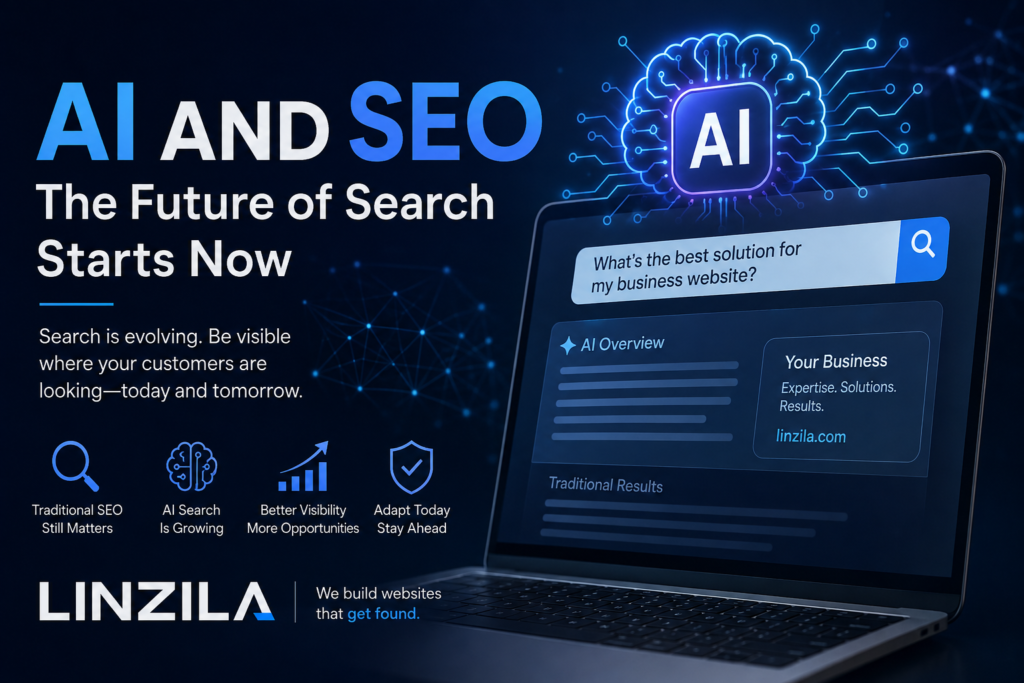
Search engines are increasingly integrating artificial intelligence directly into the search experience. Google now includes AI Overviews and AI Mode alongside traditional search results, while people are also becoming accustomed to asking longer, more conversational questions instead of searching with a few keywords.
Google itself describes generative AI as another evolution of Search and confirms that established SEO best practices remain fundamental to appearing within its AI-powered search experiences.
For businesses, this means SEO can no longer be approached simply as “ranking for keywords.”
The new challenge is broader:
Can search engines understand your business?
Can they understand what you offer?
Can they identify your expertise?
And when someone asks a relevant question, can search and AI systems confidently identify your website as a useful source?
Traditional SEO Is Not Disappearing
There is plenty of discussion about AI replacing traditional search, but SEO is not becoming irrelevant.
It is evolving.
Google states that the same foundational SEO practices used for normal Google Search also apply to its AI features. A page generally needs to be accessible, indexable and eligible for Google Search before it can appear as a supporting source within AI Overviews or AI Mode.
That makes technical SEO, website structure, internal linking, useful content and good user experience just as important as before.
What is changing is how that information can be discovered and presented.
Instead of searching:
“WordPress developer”
someone might ask:
“What type of website should I build for a small service business that needs online bookings and multilingual content?”
That is a much more specific question.
Businesses therefore need content that explains their services clearly enough to answer real questions rather than pages created simply around individual keywords.
From SEO to Search Visibility
At Linzila, we believe businesses should start thinking about overall search visibility rather than treating Google rankings as the only objective.
A modern visibility strategy should consider traditional organic search, AI-assisted search experiences, technical SEO, website architecture, structured data, content quality and the overall authority and clarity of a website.
This is why our SEO, AI & Search Visibility service combines traditional SEO principles with preparation for the changing search environment.
The objective is not to chase every new AI trend.
It is to build a website that is technically accessible, understandable and genuinely useful, regardless of how people discover it.
AI Search Still Needs Good Websites
AI changes how information is presented, but it does not remove the need for high-quality websites.
Google’s current guidance for generative AI search places particular emphasis on unique, useful and non-commodity content. Google specifically recommends bringing first-hand experience and original perspectives to a website rather than simply reproducing information that already exists elsewhere.
This makes the quality of the underlying website increasingly important.
A business website should clearly communicate:
- Who the company is
- What services it provides
- Who those services are intended for
- What experience the company has
- Where and how it operates
- How its services solve customer problems
- Why someone should trust the information provided
Strong service pages, project examples, FAQs, articles and supporting information help build this context.
The website itself also needs to be technically sound.
Google recommends secure, fast, accessible websites that work properly across devices, while its Search guidance stresses that search engines must be able to access and understand the site’s content.
This is one reason SEO should not be separated completely from Web Design & Development.
A beautiful website that search engines struggle to understand is a missed opportunity.
Structured Information Is Becoming More Important
Search systems need context.
Clear headings, logical navigation, internal links, descriptive page titles and structured data can help machines understand the relationship between a business, its services and its content.
Google confirms that structured data helps it understand page content and can make pages eligible for certain enhanced search features.
For example, your website should make it easy to determine that one page describes your company, another describes a service, another answers frequently asked questions and another demonstrates a completed project.
Good website architecture connects those pieces.
Internal linking is therefore not simply an SEO technique. It creates relationships between information.
An article discussing selling products online, for example, can naturally direct visitors to an E-Commerce & WooCommerce Development service page.
A technical article can point visitors toward Website Maintenance & Technical Support.
Those connections help both visitors and search systems understand the wider context of your website.
Content Quality Matters More Than Content Quantity
The arrival of generative tools has made it extremely easy to publish enormous amounts of content.
That does not mean publishing hundreds of generic articles is a good SEO strategy.
Google explicitly warns that generating many pages without providing additional value can violate its policies against scaled content abuse. Its guidance continues to emphasize accuracy, quality, relevance and useful content created primarily for people.
Businesses therefore need a content strategy rather than simply a content volume strategy.
One genuinely useful article based on real expertise can be more valuable to a business than dozens of pages repeating information already available elsewhere.
This also creates an opportunity for smaller companies.
You may not be able to publish as much content as a multinational company, but you can publish specific knowledge based on your actual experience, customers, projects and industry.
That is information competitors cannot reproduce as easily.
SEO and AI Visibility Start With Understanding the Customer
The most important question is not:
“What does the algorithm want?”
It is:
“What does my potential customer need to know?”
Someone considering a new website might want to know how much it costs, how long development takes, whether WordPress is appropriate, whether the website can support multiple languages or what happens after launch.
Someone considering an online store may have questions about WooCommerce, payment systems, shipping, product management or ongoing maintenance.
These are real customer questions.
Answering them properly creates useful website content while naturally giving search systems more context about your expertise.
Google’s own Search Essentials recommends creating helpful, reliable, people-first content and using terminology that people themselves are likely to use when searching.
Good SEO and good communication are increasingly becoming the same thing.
The Website Cannot Be Forgotten After Launch
Search visibility is not a one-time project.
Websites change. Search technology changes. Competitors change. Content becomes outdated. Plugins and platforms require updates.
A website that performed well two years ago may need technical, structural or content improvements today.
Regular monitoring and Website Maintenance & Technical Support can therefore support SEO indirectly as well as keeping the website secure and operational.
Technical problems such as broken pages, incorrect redirects, indexing issues, poor mobile performance or outdated website components can undermine otherwise strong content.
SEO needs a solid technical foundation.
AI Creates an Opportunity for Businesses That Adapt Early
The transition toward AI-assisted search should not be viewed only as a threat to traditional website traffic.
It also creates new opportunities.
Search queries are becoming more detailed and conversational. Businesses with clear, authoritative and genuinely useful content have more opportunities to provide answers to very specific customer questions.
Google has even started testing dedicated Search Console reporting for visibility within generative AI features such as AI Overviews and AI Mode, demonstrating how AI visibility is becoming a measurable part of search performance.
The businesses that benefit will not necessarily be those publishing the most content.
They are more likely to be businesses that make it easy to understand exactly who they are, what they know and how they can help.
How Linzila Can Help
At Linzila, we approach SEO as part of the complete website rather than an isolated marketing activity.
We can help evaluate and improve your website across several connected areas:
- Technical SEO and website structure
- SEO content and service-page optimization
- AI search visibility
- Structured data and website semantics
- Internal linking
- WordPress optimization
- WooCommerce optimization
- Website performance
- Multilingual website structure
- Ongoing maintenance and technical improvements
Our SEO, AI & Search Visibility service focuses on making websites easier for both people and modern search systems to understand.
When deeper technical changes are required, our Web Design & Development services can address the underlying website structure and functionality.
For online stores, our E-Commerce & WooCommerce Development service connects search visibility with the technical and commercial requirements of e-commerce.
And through Website Maintenance & Technical Support, we can continue monitoring and improving the website after launch.
The Future of Search Has Already Started
SEO is not dead.
But the definition of SEO is becoming broader.
Businesses now need to think about traditional search rankings, AI-powered search experiences, website quality, technical accessibility, structured information, authority and useful content as interconnected parts of the same strategy.
The fundamentals remain remarkably consistent: build a good website, provide genuinely useful information, demonstrate real expertise and make your content easy to understand.
What is changing is how that information reaches potential customers.
Businesses that start adapting now will be better positioned as search continues to evolve.
If you want to understand how prepared your website is for traditional search and AI-powered discovery, contact Linzila and we can review where improvements could make the biggest difference.